
When we talk about how a military service gets built, we usually reach for the language of hardware and budgets. Satellites and sensors. Doctrine and org charts. The blueprint of a warfighting force.
But sit with Chief of Space Operations General Chance Saltzman and his wife Jennifer for an hour, in the residence where the two live, and a different story emerges. The Space Force was not assembled from a blueprint. For much of its earliest history there was no blueprint to work from. It was built the same way the Saltzmans built a marriage and a life across thirty-five years and a long list of moves: by walking toward the thing nobody had figured out yet, and sorting it out together.
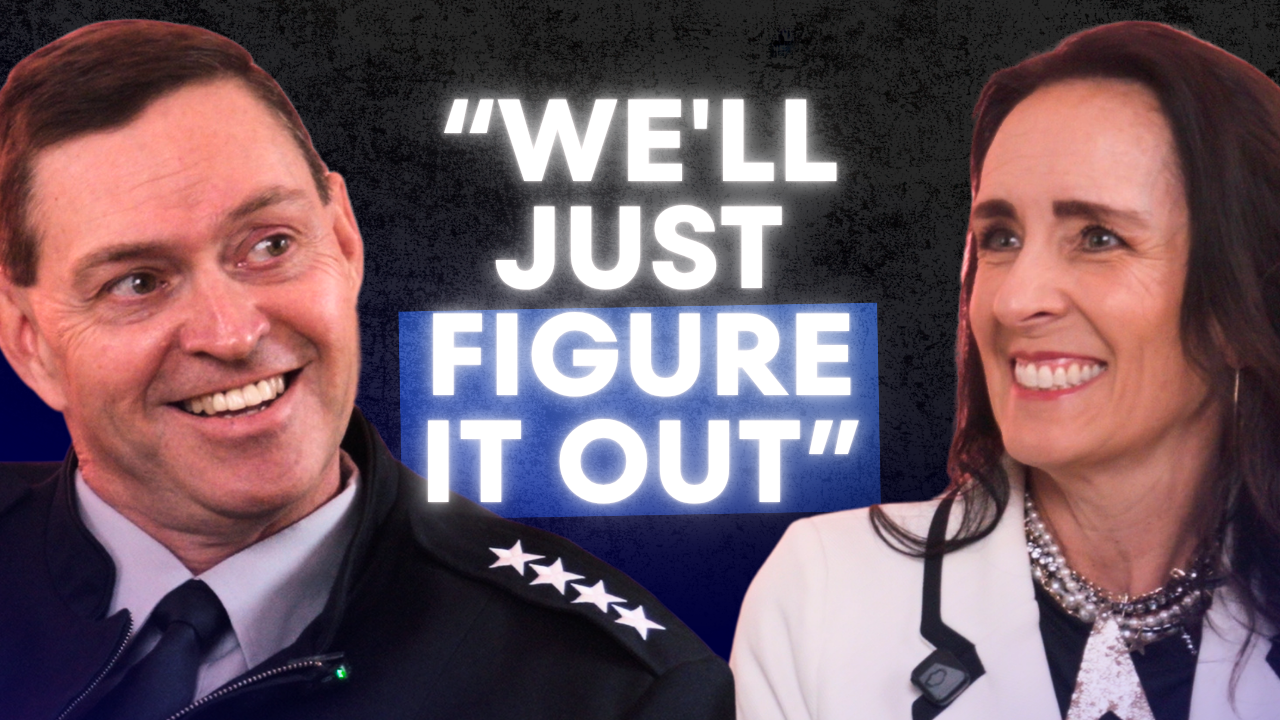
“I guess we’re in this together,” Saltzman remembers deciding early on. “We’ll just sort it out as we go.” He was describing a young engagement and an uncertain future in uniform. He could just as easily have been describing the founding of a service.
The Best Sensor
General Chance Saltzman is the second Chief of Space Operations, the officer who sits on the Joint Chiefs of Staff and answers for the readiness of the entire United States Space Force. He came up as an intercontinental ballistic missile operator, flew satellites at the National Reconnaissance Office, earned one of the first space slots at the Air Force Weapons School, and was among the very first general officers to commission into the new service. Jennifer Saltzman has been beside him the entire way, through years in a Nellis cul-de-sac and a year apart while he helped run the air war over the Middle East. In his own telling, she is not a supporting character in that career. She is, as he puts it, “my best sensor.”
That framing matters, because as Saltzman nears the end of his tenure, the question hanging over the young service is not really about technology. It is about identity. What does it mean to be a Guardian? What kind of culture is worth building, and how much of it has to be invented from nothing? The Saltzmans have spent their whole lives answering a smaller version of that question, and their answer turns out to scale.
An Unproven Path
The pattern started before either of them knew it was a pattern. They had known each other since junior high in Bowling Green, Kentucky, and reconnected years later when a delayed entry date sent a newly commissioned lieutenant back home for ten months. They were engaged two weeks before he left for missile training, with only the faintest idea of what came next. “You just figure it out,” Jennifer says of those first years. “That is just your normal.”
Saltzman tells the story of his own career as a series of doors he backed through rather than planned for. His ROTC scholarship was in physics, a subject he gave everything to for about three semesters before conceding it “was not going to work out for anybody.” Switching to a non-technical degree meant giving up the scholarship, unless he was willing to become a missile operator. He said yes without hesitating. “They thought they were getting a good deal,” he says, “and I knew I was getting a good deal.”
The instinct sharpened into something close to a philosophy at the Weapons School. The program was new, and space officers were an unproven addition to it. When Saltzman called a senior officer at the personnel center for advice, the answer was blunt. “That’s a terrible idea,” the man told him, an unproven path with no telling where it led. For most people that would have closed the door. For Saltzman it opened one. “When I hung up with him,” he recalls, “I’m like, that’s what I’m going to do.” He puts the logic plainly: “An unproven path? How could you go wrong there?”
Every unproven path he chose was a path Jennifer agreed to walk without a map. She describes the discipline it took, the decision to put herself out there in each new place rather than wait inside for the assignment to end. When he announced they were leaving Silicon Valley for a summer drive across the desert to Las Vegas in a car with no air conditioning, she was, by his account, “not very pleased.” Two years later she called it one of their best assignments. The lesson she draws is not that every move was good. It is that a place “gives you something that you never would have had before,” provided you are willing to go looking for it.
Combat Operations and Soccer Practice
That willingness to walk into the undefined eventually met a moment that would redefine an entire domain. In January 2007, Saltzman was in charge of operations on the floor of the Joint Space Operations Center when China launched a missile at one of its own defunct satellites. He watched the intercept unfold in real time. “We have multiple headcount,” the missile operator told him, the phrase radars use when one object in space suddenly becomes many. There was, he realized, no hand signal to convey what had just happened to the general waiting behind a plate glass window, so he ran around to deliver it in person. “They destroyed the satellite,” he said, and the call went up to the Secretary of Defense. From that day forward, he understood, “space would forever be contested.”
What he describes next is the detail that makes the Space Force unlike any service before it. Guardians conduct combat operations from garrison. They do not deploy to fight. They fight from bases inside the United States and then go home. So on the day he watched a rival nation change the rules of space, Saltzman got in his car and drove home, where Jennifer was waiting. “We’re late for soccer practice,” he remembers her saying. “Grab the oranges. We’re on our way.” You conduct missile warning and intelligence collection all day, he says, and then “you just have to go home and help your grade school kid with math.” For Jennifer, watching from the other side of that classified wall, the same day registered simply as “just another work day.”
The service itself arrived the way the rest of their life had, faster than anyone was ready for and without a manual. Saltzman was deployed in the Middle East when the decision came down. He had assumed a Space Force was a distant idea, certainly nothing that would touch his own career. “Sure enough,” he says, “like three months later, there just is a Space Force.” A call came asking him to return and build the operational side. He compares the feeling to “the dog that catches the bumper.” Years of arguing that the country needed a Space Force, and now the arguing was over and the building had to begin.
Building it meant inventing the ordinary from scratch. There was no flag, no song, no uniform, no set of performance reports designed for Guardians rather than borrowed from the Air Force. Saltzman is candid that these were not trivial chores to be waved away. “There’s just a certain tax that comes with being a service,” he says, “and you have to pay the tax.” The point was made unforgettable when he was told, on the day of his own promotion to three stars, that if a Space Force flag was not standing at the Pentagon entrance before the ceremony, “you’re not getting your third star.”
His one real regret is instructive, and it is a regret about patience rather than speed. The Space Force still relies on what are essentially Air Force performance reports. Saltzman slowed that project down on purpose, because a performance report is not just paperwork. It documents what a service values and how it tells people they matter. “A Guardian identity is so important,” he says, that he would rather get it right slowly than get it wrong quickly. It is the same deliberate patience the couple learned assignment by assignment, applied now to the culture of an institution.
Connection as Infrastructure
Connection is not a soft skill in this line of work. It is infrastructure. The Saltzmans learned that as a young couple at Malmstrom Air Force Base in Montana, where Jennifer managed a newborn while her husband disappeared for thirty-hour alerts and both of them leaned on a community of people in exactly the same situation. Everyone was the same age, everyone was new, and nobody knew what they were doing. Looking around a room of them years later, Jennifer remembers thinking, “Are we the adults? Who’s in charge of us?” One of their friends eventually gave Saltzman a shirt that read, “Bad decisions make the best stories.” They grew up together, and so did the friendships, which is why the people who knew them then are still the people they keep now.
That belief in connection is exactly how Saltzman leads. When he and Jennifer visit Guardians in the field, he says, “we don’t talk, we listen.” He gave up long ago on the idea that a commander lecturing from a stage teaches anyone very much. Instead he sits with small groups of junior enlisted, company grade officers, and squadron commanders, and lets them talk to each other while he takes notes. Here the partnership becomes a genuine instrument of command. Jennifer sits with the spouses, in small groups of her own, and the truth flows to her. “She’s my best sensor,” Saltzman says, because Guardians “will tell her things that I know they would never tell me.” Rank closes some doors. Jennifer opens them.
She has watched the culture shift in real time. Spouses now receive threat briefings, something that did not happen for most of their career, and the effect on the families has been striking. When a spouse understands how real the threat in space actually is, Jennifer explains, buy-in follows, and a family that understands the mission is a family that can sustain a career. It is the connection principle again, scaled from a Montana cul-de-sac to a national force.
For all of it, the anchor stays in Bowling Green. When the Saltzmans go home to Kentucky, the childhood friends there have, in his words, “no appreciation whatsoever for what a two star general does,” and, he adds, “that’s just the way I like it.” Back there he is not the Chief of Space Operations. He is Chance, and she is Jennifer, and they are two graduates of Bowling Green High School picking up a conversation they started in the 1980s. A service that spends so much energy building an identity is led, it turns out, by a man who is careful never to lose his own.
Why This Conversation Matters
The Space Force will be measured, rightly, by its satellites and its sensors, its doctrine and its readiness. But this conversation is a reminder that institutions are built by people, and that the qualities holding a marriage together across thirty-five years are not so different from the ones that hold a young service together through its first uncertain decade. A willingness to walk the unproven path. The patience to build an identity slowly. The conviction that connection is not decoration but foundation.
None of that comes through on a fact sheet. It comes through in the way Chance and Jennifer Saltzman finish each other’s stories, correct each other’s timelines, and land, again and again, on the same five unglamorous words that have carried them from a college summer party to the Joint Chiefs of Staff. We will figure it out. The full conversation carries a warmth and a candor that no summary can. There is a great deal more in it than fits here, including the night a Hollywood director came to dinner and the story of how a physics dropout ended up flying some of the nation’s most secret satellites.
Hear General Chance Saltzman and Jennifer Saltzman tell it themselves, you come away understanding something a slide can never quite capture: how a service, like a marriage, gets built one unmapped step at a time.
Listen and Learn More
Listen to the full episode of the Spacepower Podcast on YouTube, Apple Podcasts, and Spotify.