
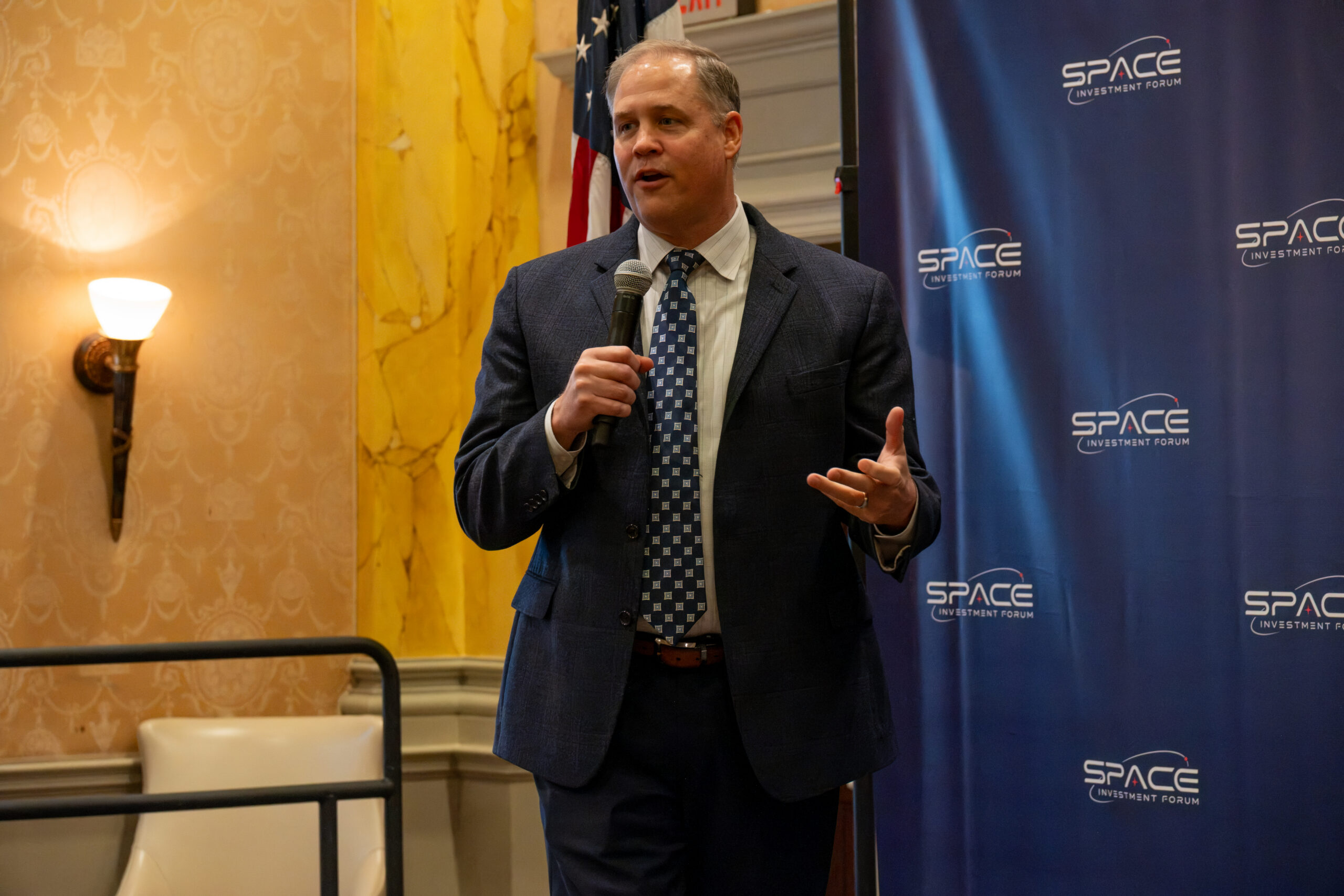
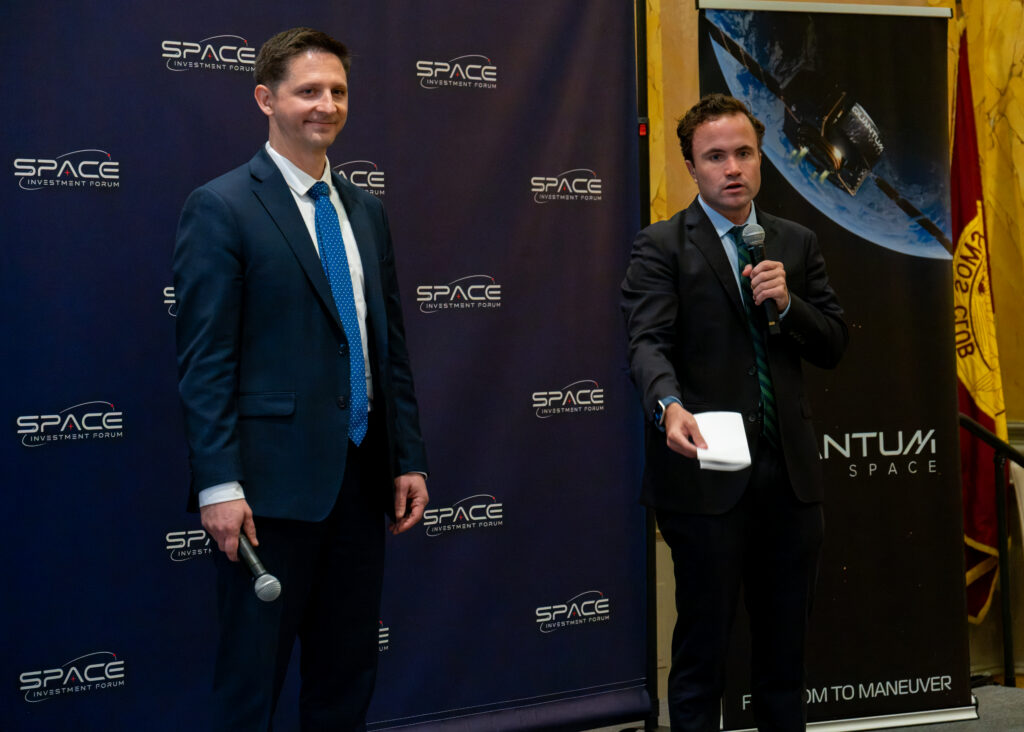
On July 21, policymakers, industry leaders, and members of the press gathered at the Cosmos Club in Washington, D.C. for the Space Investment Forum, a wide-ranging conversation on how security, commerce, and innovation in space are becoming inseparable. The forum was co-hosted by Kevin Cirilli, co-founder of mtf.news and host of the Meet the Future podcast, and Jake Matthews, Founder and CEO of Potomac Database Systems.
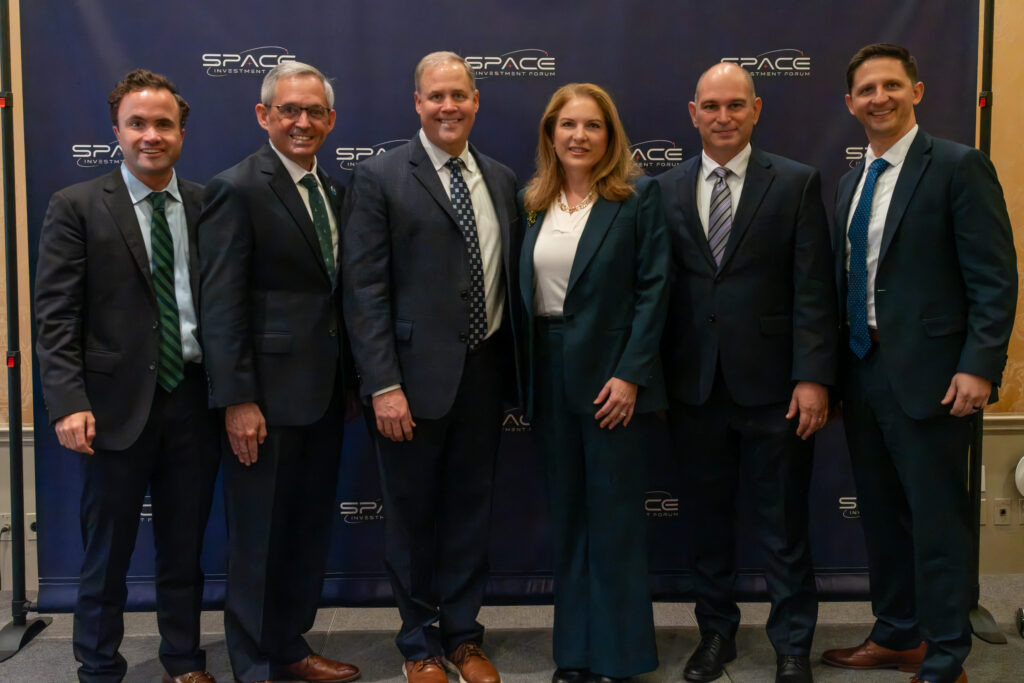
Following a private breakfast, the morning opened with remarks from Space Force Association’s CEO Damon Feltman, continued with a keynote from former NASA Administrator and Quantum Space CEO Jim Bridenstine, and closed with a panel, “Powering Permanence: Commercial Nuclear Energy and the Architecture of the Space Economy,” featuring Lt. Gen. (Ret.) Mary F. O’Brien, Jake Matthews, and Peter Cabauy, PhD, of City Labs, moderated by Cirilli.
The throughline of the day was consequential: the security the United States provides in space is the foundation the space economy is built on and both are now being tested by faster-moving competitors and a workforce and infrastructure base that hasn’t caught up. Here are six takeaways from the forum.
1. Security in space is the engine behind the space economy
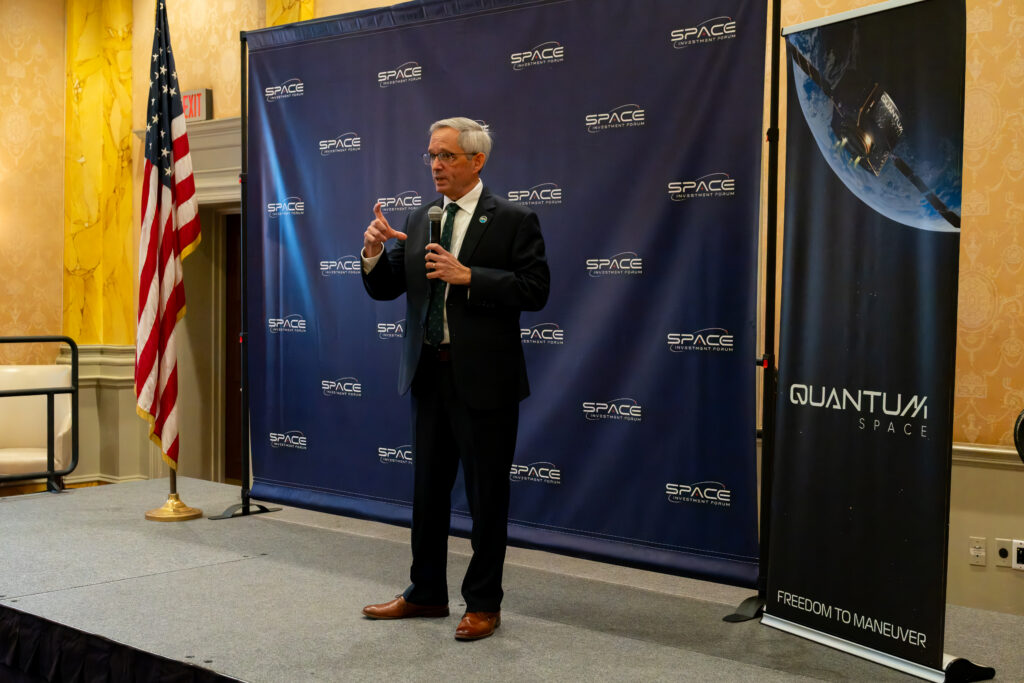
Feltman opened by framing space through the lens of national power: the diplomatic, information, military, and economic tools the United States uses on the world stage. He illustrated that the same security that lets commercial shipping cross the oceans or airlines fly point-to-point around the globe is what allows companies to invest and build in space. “The U.S. is in the lead, but China is catching up fast,” Feltman noted, and the budget choices made today will determine whether that lead holds long enough for the commercial space economy to fully take root. As he put it: “If the U.S. can create, lead, and guarantee security in the space environment, the space economy itself can grow as well.”
2. The sacrifice behind the Space Force is easy to overlook
It’s tempting to picture the Space Force as a service confined to operations centers in Colorado or launch pads in California. Feltman offered a different picture: roughly 1,200 Guardians are currently deployed in the CENTCOM area of responsibility, where they’ve weathered more than a thousand missile and drone strikes over the course of the ongoing conflict. At forward installations, Guardians tied into missile-warning systems are often the last personnel to take cover during an inbound attack. “They’re literally watching the threat come in, taking cover at the last second, then getting back out to provide warning and defense for the force,” Feltman said. It’s a reminder that “spacepower” isn’t an abstract concept. It includes boots on the ground in conflict zones.
3. Scaling launch means scaling the workforce, not just the rockets
Asked where the next bottleneck in the space economy will emerge, Feltman didn’t point to hardware, but rather to people. “The bottlenecks are everywhere, to scale,” he said. The Space Force estimates it will need roughly “3,000 launches a year” by 2040, a figure Feltman called “a gigantic number” compared to today’s pace, concentrated mostly on the East and West Coasts. Getting there requires more than STEM graduates; it requires the full pipeline — technicians, tradespeople, contracting specialists, and lawyers — that makes a launch industry function at scale. “Space is not just fabricating the rocket,” he noted, adding that producing rocket scientists is only half the equation.
4. The rules of space will be written by someone. The question is who.
Perhaps the sharpest line of the day came in response to a question about legislative gaps in space policy. “At the end of the day, it’s a binary choice,” Feltman said. “The future of space is going to be governed either by an authoritarian, China-style system, or it will be governed by liberal democracies. There’s no middle ground, and for policymakers to ignore that reality is very risky.” He added that treating today’s space environment as benign is itself a risk — evidenced, he said, by China’s pattern of ignoring international norms elsewhere, from the South China Sea to its rapidly expanding space and lunar ambitions: “It’s not much of a logical leap to conclude that if they get to the Moon ahead of us, they will attempt to set norms that are highly in their favor.”
5. Space is quietly transforming medicine and the broader economy
Jim Bridenstine’s keynote made the case that the Space Force and NASA occupy distinct lanes — one military, one diplomatic and scientific — but both feed a shared economic story. He pointed to work on the International Space Station using microgravity to produce a purer crystal form of the lung cancer drug Keytruda: “You can create that same pharmaceutical crystal in the microgravity of space that is so pure that … you’re going to find out in a matter of weeks whether or not it was efficacious, not a matter of months.” He also cited recent progress 3D-printing tissue, including a meniscus, in orbit. His larger point on NASA’s role: prove out what the commercial market doesn’t yet believe is possible, then “step back and let commercial industry capitalize on it” — a model he argued the U.S. isn’t funding aggressively enough. This includes funding for a timely replacement to the aging ISS: “We are not, as a nation, adequately funding the replacements for the International Space Station.”
6. Commercial nuclear power — and a new kind of workforce — will make permanence in space possible
The closing panel turned to the practical question of how anything survives a two-week lunar night with no sunlight and no atmosphere to moderate temperature swings. The answer, panelists agreed, is nuclear micropower, technology recently proven out commercially for the first time, enabling sensors and landers that can operate independent of the sun. Just as important was the discussion of who builds and operates these systems: panelists described an emerging category of “space collar jobs” that blend nuclear expertise, engineering, and hands-on technical skill. As Peter Cabauy put it, what matters most isn’t a specific degree but “chispa” — the Spanish word for spark. “You see it when they have it … it could be a technician, it could be an engineer, it could be a fourth-grade teacher — they just have to have that spark, the desire to get it done,” Cabauy said. Jake Matthews made a similar case for rethinking career pathways for technicians, who he said are “worth their weight in gold on the design side” and deserve “a career trajectory that matches the value that they provide.”