The future of American spacepower isn’t built in orbit. It’s built in classrooms.
Every Guardian who will operate satellite constellations, every engineer who will design next-generation propulsion systems, every acquisition professional who will manage billion-dollar programs, they all started somewhere. A teacher who made physics click. A demonstration that turned abstract concepts into tangible wonder. A moment when space stopped being something that happened to other people and became something they could build.
The pipeline from elementary school curiosity to national security capability is longer than most people realize. And right now, it’s more fragile than we can afford.
When the Launch Director and the Teacher Share a Last Name
Col. Eric Zarybniski manages how America gets to orbit. As Portfolio Acquisition Executive for Space Access at Space Systems Command, he’s responsible for $13.5 billion in national security space launch programs, delivering critical payloads from Cape Canaveral and Vandenberg that enable everything from missile warning to GPS. His wife, Dr. Emily Zarybniski, was recently selected as one of 38 educators worldwide to join the Space Foundation’s 2026 International Teacher Liaison Program. She works with elementary and middle school students, many of whom will one day design, build, or operate the systems her husband launches today.
Their careers intersect at a question that matters far beyond one military family: How do we ensure the United States has the space workforce it needs to maintain superiority in the domain?
“When an opportunity falls into my lap, I tend to just run with it and enjoy the heck out of it,” Dr. Zarybniski reflects on her path as both a military spouse and educator. “To transition from a classroom teacher to a STEAM resource teacher has really allowed me the chance to dig into some of my passions […] and inspire the next generation.”
The Space-Native Generation That Doesn’t Know It Yet
Today’s students are the most space-dependent generation in history. They’ve never known a day without GPS guiding them to school, satellites delivering their favorite shows, or weather forecasts pulled from orbit. They check apps powered by constellations. They video call relatives using relay networks in space. By some estimates, the average person touches space-enabled technology 50 times a day, and has no idea it’s happening.
This generation will live through humanity’s return to the Moon, the first crewed missions to Mars, and the expansion of commercial space stations. They’ll see capabilities their parents never imagined. But ask most students what careers exist in space, and they’ll say “astronaut” and then go quiet. The engineers who design thermal protection systems, the operators who manage orbital mechanics, the mission planners who coordinate global satellite networks, those jobs don’t register as possibilities.
“Space Force is real. Guardians are real,” Col. Zarybniski says, recounting the number of times he’s had to explain his uniform to people who’ve never seen it before. “I turn in my rental car and more than once […] they look at my ID and say, Space Force, what’s that? I’ve never seen one of these before.” This was in Colorado Springs, home to thousands of Guardians. “We’ve got to get the word out that the Space Force is real. We’re doing great things for the nation.”
The disconnect runs deeper than public awareness. If students can’t see themselves in those roles early, they’re gone before high school. Dr. Zarybniski sees it firsthand in her classroom. “To be able to go back and tell the kids about the experience, to get them excited about […] designing a rocket or engineering or the launch day or designing a patch for a mission,” she explains. “And to know that anyone who wants to be in space has a place.”
That last line matters. Anyone who wants to be in space has a place. Not just the kids who excel at calculus. Not just the ones who fit the traditional “rocket scientist” mold.
STEAM, Not Just STEM, and Why It Matters Operationally
Col. Zarybniski is quick to correct the conventional framing. “I’ll expand from STEM to STEAM, and I’ll explain why,” he says. “I’m a mathematician. I love math. But that’s not all we need.”
The “A” stands for Arts, and it’s not decorative. The space enterprise needs people who can design mission patches, build simulations that help operators visualize complex orbital mechanics, and create the user interfaces that turn raw telemetry into actionable intelligence. “Kids that have different ideas and different passions can all come together in the space enterprise and really make the mission successful,” he continues. “Somebody’s got to go build those simulations that help people like me understand exactly what’s going to happen on orbit. That’s a skill I don’t have.”
Dr. Zarybniski echoes this in her classroom approach. When an astronaut visited her school, one of her students, nine or ten years old, wrote a thank-you note describing all the things she was going to explore when she went to space. “To see her excitement,” Dr. Zarybniski says, “she’s 9 or 10 years old, and to be so confident in knowing that’s where she’s headed.”
That confidence doesn’t happen by accident. It happens because a teacher creates space for curiosity, shows students the breadth of what’s possible, and doesn’t let them narrow their options before they’ve explored them.
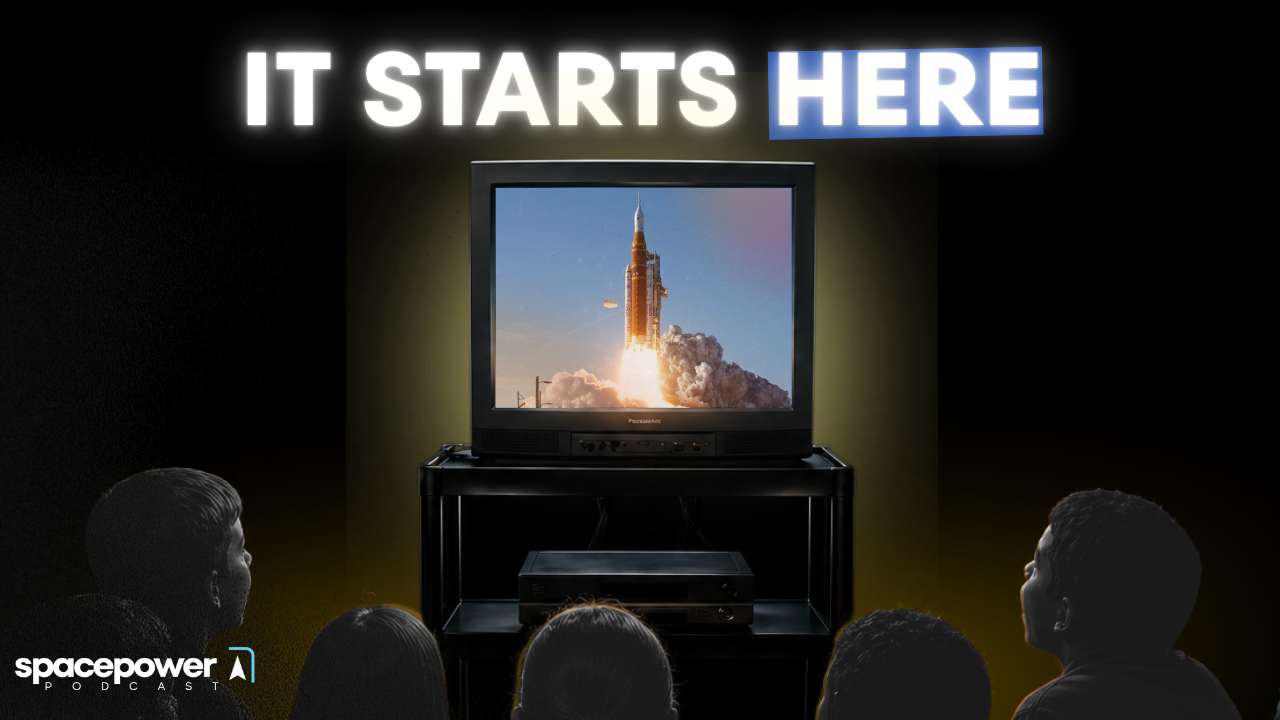
As this generation grows up alongside Artemis missions and commercial space stations, as they watch the boundary of human exploration push outward, the question becomes: Will they see themselves as spectators or participants? The answer depends on what happens in classrooms today.
Dinner Table Quantum Physics and Kitchen Thermodynamics
The Zarybniski household doesn’t separate work from education. When their daughter called from college to say the refrigerator was making strange noises, Col. Zarybniski didn’t just troubleshoot the appliance. “We pulled out a textbook and we explained thermodynamics at the dinner table,” he says. “It’s how you get kids understanding what’s going on, excited about it. So many people are scared of […] I’m not good at math and I’m not good at engineering. Find what you’re good at, and I bet you can connect to that.”
Dr. Zarybniski describes walks around the neighborhood where her husband explains quantum physics in response to a casual question. She describes textbooks spread across the kitchen table when one of their kids asks how something works. “There have been moments […] when my kids will ask a question, and it can be a really simple question. What makes a car stop? […] But all of a sudden, you see textbooks coming out of the basement, and they’re laid across the kitchen table, and all of a sudden, we are having college-level lectures at our dinner table.”
It’s not just about answering questions. It’s about modeling the behavior that curiosity is rewarded, that complexity can be understood, that “I don’t know” is the beginning of learning, not the end.
“As an educator, we talk a lot about early conversations with kids,” Dr. Zarybniski says. “And that leads to academic success as they continue to grow. […] I love to tell you that at 21, 19, and 16, they still ask all of those questions.”
What Teachers and Parents Can Do Right Now
The Space Foundation’s International Teacher Liaison Program isn’t just recognition. It’s infrastructure. More than 400 educators across 25 countries now have access to space-themed lesson plans, professional development, and a network of experts they can call when a student asks a question they can’t answer. “To be able to have conversations and excitement and share resources with people, to be part of that community is a great honor,” Dr. Zarybniski says.
But the work doesn’t require elite credentials. It requires commitment to not letting students opt out of curiosity. Col. Zarybniski describes bringing Diet Coke and Mentos into classrooms, showing students that a chemical reaction they can see and touch scales to the physics that puts rockets into orbit. “You wouldn’t expect they know what Mentos are, they know what Diet Coke is, put them together and something amazing happens,” he says. “Now let’s convert that into making a rocket fly.”
Dr. Zarybniski adds: “Putting things in kids’ hands and letting them experiment and to try. And […] inviting that curiosity perpetually and seeing what they get excited about, what questions do they have, […] it goes back to that why or what if.”
The students in her classroom today will come of age as humanity establishes permanent presence on the Moon, as commercial space stations become routine, as the first Mars missions launch. They’ll inherit a space domain far more complex and contested than the one their parents knew. Whether they’re prepared to defend and advance it starts now.
Why This Conversation Matters
The Space Force of 2040 is sitting in fourth grade classrooms right now. Whether those students pursue careers in space, whether they see themselves as capable of contributing to the mission, depends on what happens in those classrooms over the next few years.
This isn’t workforce development as an afterthought. It’s foundational to space superiority. The satellites, the launch systems, the ground infrastructure, all of it requires people who understand how it works, how to operate it, how to fix it when adversaries try to break it. And those people don’t appear fully formed. They’re built, one curious question at a time, by educators who believe every student has a place in the space enterprise.
Hear Col. and Dr. Zarybniski explain it in their own words. The full conversation covers how they balance launching rockets and teaching students, what it’s like to be a military family embedded in the space mission, and why answering a child’s question might be the most strategic thing you do today.
Listen to the full episode on Youtube, Apple Podcasts, Spotify, or at ussfa.org.
Learn more:
Space Foundation Teacher Liaison Program: discoverspace.org/education/resources-for-educators/teacher-liaisons
Space Systems Command: ssc.spaceforce.mil
U.S. Space Force: spaceforce.mil
Join the Space Force Association to support the mission and the people defending America’s space superiority.