
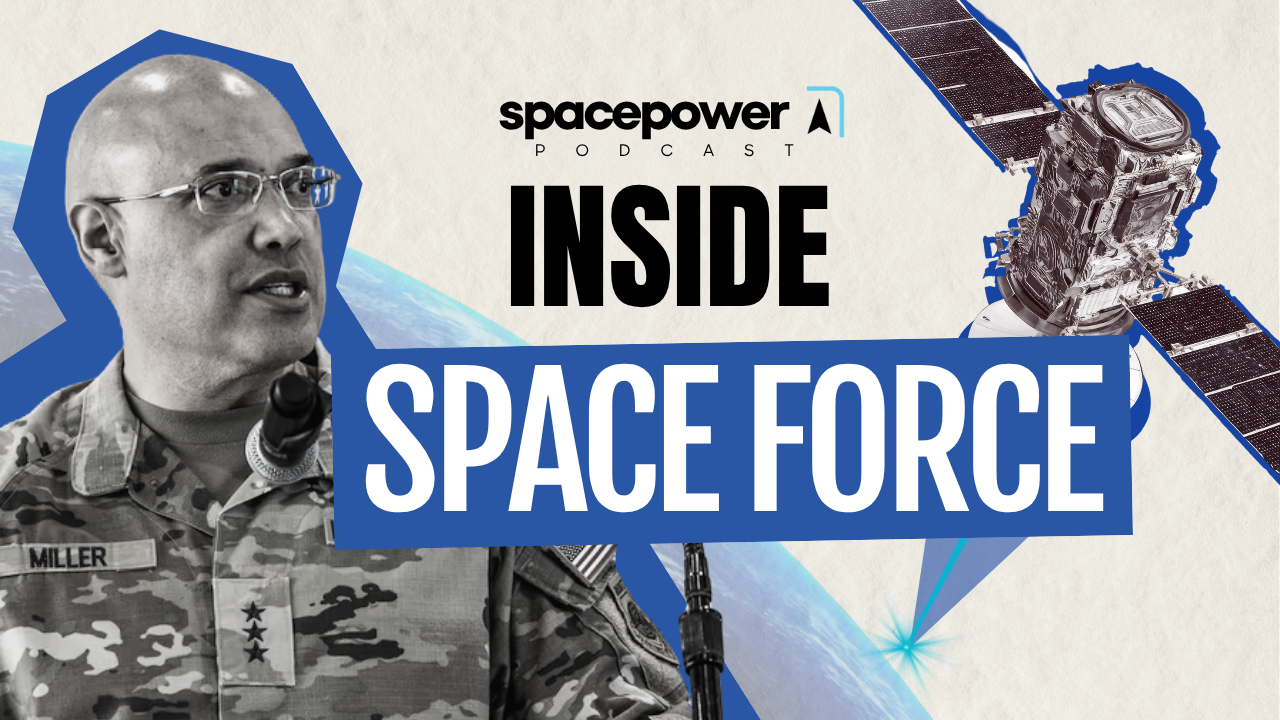
There is a moment early in the conversation where Lt. Gen. Miller pauses, not for effect, but because the weight of what he is describing demands it. Space superiority, as he frames it on the Spacepower Podcast, is not a slogan or a doctrinal buzzword. It is a condition that must be deliberately built, continuously assessed, and, if necessary, fought for.
He says, “Space superiority is about ensuring freedom of action for ourselves while denying it to adversaries.” The definition is simple, but the reality is anything but. The domain has expanded, threats have matured, and expectations for space power have grown far beyond what they were even a decade ago.
A Contested Domain
The United States did not step into a static environment when it established the United States Space Force. It entered a contested one.
Miller notes, “Our competitors didn’t wait for us to organize, they built their forces and capabilities years ago.” China alone now has roughly 1,500 satellites, many focused on intelligence, surveillance, and targeting. This growth reframes space capabilities from assumed infrastructure to critical, contested assets.
From Support to Warfighting
“Space is no longer just an enabler,” Miller emphasizes. Systems that were once seen as background are now essential to precision navigation, missile warning, communications, and targeting. That dependence creates both strength and vulnerability. Degrade those systems, and the joint force feels it across every domain.
The Space Force must now ensure these capabilities survive disruption and continue operating under pressure, requiring systems that are resilient, distributed, and integrated.
Expanding Mission Areas
“There are mission areas today that didn’t exist even in our vocabulary ten years ago,” Miller says. Space-based sensing, moving target indication from orbit, and advanced missile tracking are now core responsibilities. Even orbital warfare, once a fringe discussion, is now part of doctrine.
The mission expansion drives growth. The Space Force is not doing more of the same—it is taking on entirely new responsibilities that require new systems, training, and personnel.
Designing the Objective Force
Miller describes the objective force as “a roadmap for where we need to be over the next decade and beyond.” It defines what capabilities are needed, how they should be organized, and when they must be delivered.
It is deliberately flexible. “Space evolves too quickly for fixed assumptions,” he says. Flexibility is foundational.
People and Training
Miller highlights the Guardians themselves: “Young people are stepping into new missions with ownership and urgency.” Training has shifted to immersive, real-world preparation. Units are aligned with operational demands, and leadership courses emphasize command and responsibility early in careers.
Changing How Capability Gets Delivered
Acquisition is also evolving. Miller explains, “We’ve moved from rigid system specs to mission-level requirements. We define the outcomes, and let teams figure out how to get there.”
This includes delivering minimum viable capabilities quickly and improving over time, with operators involved early. The goal is to field systems that are operationally effective, not just technically compliant.
A Joint and Allied Effort
Miller is clear: space superiority is not achieved alone. US Space Command, allied partners, and industry all play crucial roles. Coordination ensures capabilities complement one another, while a responsive industrial base drives innovation, production, and iteration.
Why This Conversation Matters
This episode of the Spacepower Podcast stands out for its clarity. The challenges are real: contested domain, expanded missions, and the need for rapid, deliberate growth. Yet there is direction. As Miller states, “We are building deliberately toward a future where space superiority is not assumed, but ensured.”
Listen to the Full Episode
Hear Lt. Gen. Miller explain in his own words how the Space Force is building and sustaining space superiority on the Spacepower Podcast.
Youtube: https://youtu.be/qLrGpwhGnI8
Spotify: https://open.spotify.com/show/4EHbjY42EdGTqB1EC2hAmO
Apple Music: https://podcasts.apple.com/us/podcast/spacepower/id1500399200