
There is a moment in the conversation that stops you cold.
Randy Schriver, who spent years inside the Pentagon tracking China’s military modernization, describes the day he returned to government, got his clearances back, and walked into his first intelligence briefing after a few years away. “My mind exploded,” he says. “I literally thought, how did this happen in such a short period of time?”
He is not a dramatic person. He is a former Assistant Secretary of Defense who has spent three decades studying China. And the pace of what China has built in space, the satellites, the counterspace weapons, the targeting architecture, had outrun even his expectations. General Saltzman, the Chief of Space Operations, used a different phrase to describe it. He called it “mind-boggling.” That is not a phrase you hear from a four-star general.
That exchange sets the tone for a recent episode of the Spacepower Podcast, in which SFA Founder and host Bill Woolf sat down with Randy Schriver and Mike Kuiken, the Chair and Vice Chair of the U.S.-China Economic and Security Review Commission. They were joined by co-host Dillon “Brick” Cox, Chair of SFA’s National Spacepower Center Committee. The conversation covered the Commission’s 2025 Annual Report to Congress, all 700-plus pages of it, and with particular focus on Chapter 7: “The Final Frontier: China’s Ambitions to Dominate Space.”
The Bipartisan Signal Nobody Is Talking About
The Commission is made up of twelve members: six appointed by Republican congressional leaders, six by Democratic leaders. The 2025 Annual Report was approved unanimously. In a Washington where almost nothing gets bipartisan agreement, that consensus is itself a signal.
Mike Kuiken, who spent nearly 23 years in the U.S. Senate before joining the Commission, put it plainly. He described arriving at his first Commission meeting after years of what he called “knife fighting” across the aisle, expecting more of the same. Instead, he found something different. “We were talking like puppies and unicorns and holding hands,” he says. “It was absolutely jarring.”
What produced that consensus? China. Specifically, the speed and direction of China’s space advancement. “It’s not just the speed,” Schriver says. “It’s the direction.” China has explicitly declared space a warfighting domain. Its state-owned enterprises that build civilian satellites are embedded in the People’s Liberation Army’s warfighting architecture. There is no civilian Chinese space program in any meaningful sense.
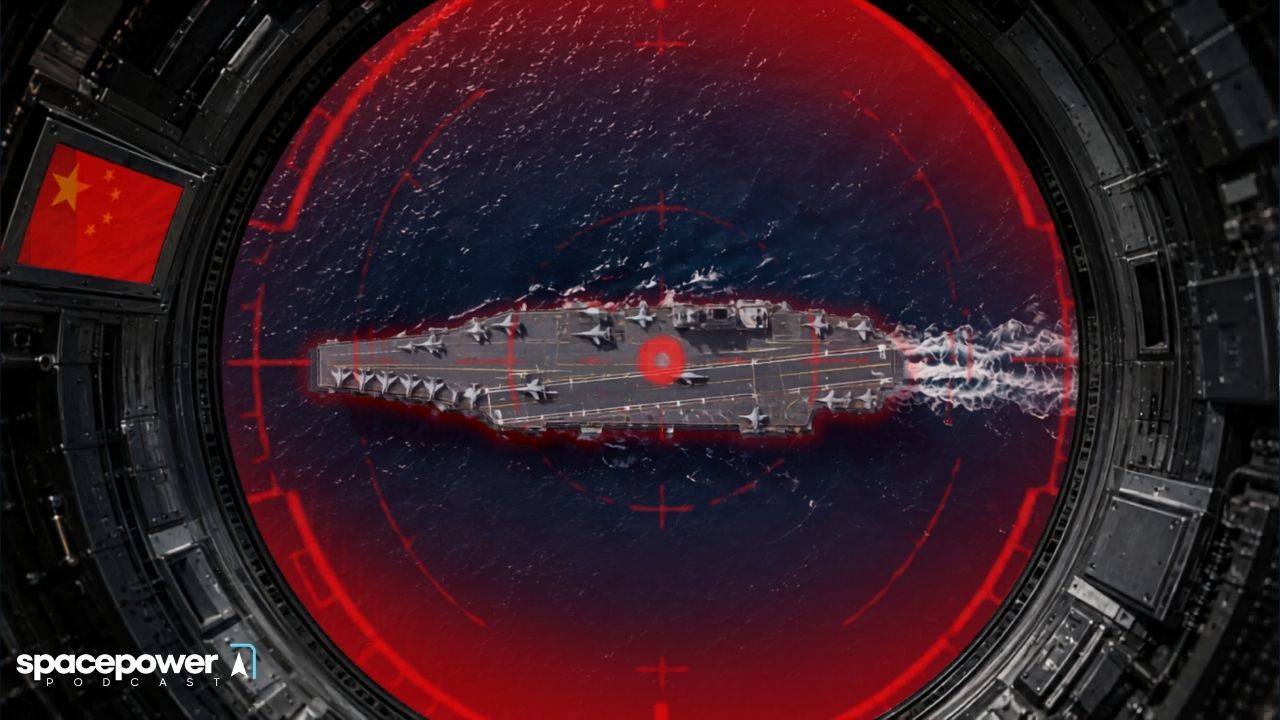
Schriver’s carrier battle group analogy made that concrete. A decade ago, a U.S. carrier strike group leaving San Diego could transit across the Pacific with only intermittent Chinese detection. Today, China can track it from the moment it leaves port, persistently, with targeting-quality data, for the entire journey. “That difference,” Schriver says, “means they can develop tracking and target quality data which can be harvested for the purposes of actually having strike capability against our carrier battle group.”
What Breaks First for Ordinary Americans
The Commission’s report is explicit that U.S. society’s dependence on satellite services is “significantly underappreciated outside national security circles.” Bill pressed on that point directly, asking what an economic degradation of U.S. space capabilities would actually look like for an American with no connection to the military.
Kuiken did not hesitate. “GPS breaks first. Let’s be straight.”
From there, it cascades. Telecommunications systems that rely on satellite infrastructure begin to degrade. Financial network timing, the invisible backbone of every digital transaction, becomes unreliable. The power grid, which depends on precision timing signals, becomes vulnerable. And Kuiken raised something else: Salt Typhoon and Volt Typhoon, the Chinese cyber operations that have already embedded themselves across American telecommunications infrastructure. “It might not be that there’s another ASAT type operation,” he says. “It might just be that the lights turn off, so to speak, in the satellite.”
The global space economy currently stands at roughly $546 billion and is projected to exceed $1 trillion by 2030. Satellite services account for nearly 70 percent of that market. The stakes are not abstract. They are every GPS navigation, every weather forecast, every credit card transaction at a gas pump.
The Standards Race Nobody Is Winning
One exchange in the conversation deserves particular attention, and it was Bill who drove it. China is not just building satellites. It is building the rules.
BeiDou, China’s navigation system, is now fully operational and globally competitive with GPS. Chinese broadband constellations are targeting the same markets as Starlink. Through the Belt and Road Initiative, China has embedded its space infrastructure, ground stations, satellites, technical standards, into dozens of countries across the developing world. And as Kuiken pointed out, China’s relationship with existing international standards is instructive: “They already don’t listen to the rules that have been around for 80 years. If they start writing the rules, how do you think they’re going to observe them?”
The answer is embedded in the question. China parks its satellites wherever it wants in low Earth orbit in violation of ITU agreements. If China becomes the dominant provider of space infrastructure for the developing world, it will set the standards for how those countries access space-enabled services for a generation. That is not a military outcome. It is an economic and geopolitical one.
The Space Force’s Visibility Problem
The Commission’s work intersects directly with the advocacy mission of the Space Force Association, and Kuiken named the challenge precisely. “The Space Force has a bit of a disability,” he says. “There’s no air show where I can go pet a joint strike fighter or walk through the belly of a C-17. Seeing a satellite is cool, but it’s abstract.”
That abstraction has real consequences. The Army has Fort Bragg. The Navy has aircraft carriers. The Space Force has operations centers full of Guardians, tracking objects and signals that are classified, in an environment that is invisible, at distances most people cannot conceptualize. You cannot walk a senator through a satellite. You cannot put a CEO in the cockpit.
Kuiken went further, pointing to a structural problem that compounds the visibility gap. “The number of members that are actually read into these programs or allowed to be read into these programs is pretty limited,” he says. “The congressional defense committees do not represent 535 members. They represent a small fraction of that.” The people who most need to understand what the Space Force does, the appropriators, the budget writers, the corporate board members whose companies depend on GPS timing, are largely locked out of the briefings that would make it real for them.
And then there is the simulation gap. Kuiken noted that if you walk onto an Air Force Reserve base, you will almost certainly find an F-16 simulator or an A-10 simulator. Guardians practice the real thing by doing the real thing. “As we transition to a warfighting domain in space,” he says, “one of the things we do have to think about is how do we make sure those Guardians have an opportunity to simulate the things that they will be asked to do in space?” Bill reinforced the point from his own conversations with General Saltzman: the Space Force is the only service where a simulator is not delivered alongside the system of record. That needs to change.
This is precisely the gap the National Spacepower Center was built to close. Dillon “Brick” Cox articulated its mission in the conversation: taking the threat picture the Commission has documented and making it visceral and experiential for senior decision-makers who have the authority to act. Not briefings. Not slide decks. Immersive, scenario-based environments where a Fortune 500 CEO or a member of Congress can actually experience what it looks like when GPS goes dark, when financial network timing degrades, when a carrier strike group loses its ability to communicate across domains. The NSpC can sit across the river from Capitol Hill and do in an afternoon what a classified briefing at Schriever cannot do for most of the people who control the Space Force’s budget.
Schriver made the same case from a diplomacy angle. He described a conversation with a senior administration official who told him plainly: “I’m trying to conduct space diplomacy, but I’m not allowed to share any of this information with my partners and allies.” The classification wall that limits congressional awareness also limits allied coordination. Shining a light on China’s behavior in the space domain, in unclassified environments where partners can actually engage, is not just a public affairs problem. It is a strategic one.
Hear the full conversation here or wherever you listen to podcasts. The exchange on what breaks first, and what the Commission would tell a lawmaker who wants to do the right thing but doesn’t know where to start, is worth the listen.
Read the 2025 Annual Report to Congress
Learn more about the U.S.-China Economic and Security Review Commission