Most people picture a weapons school as the place that takes the best operator of a single machine and makes that operator even better. The fighter community works that way: one squadron trains F-16 pilots, another trains F-35 pilots, and the platform defines the patch.
The space weapons school was built to do something harder. It trains people to think across an entire domain, to take an orbital problem, an electromagnetic problem, and a battle management problem and solve all three at once under pressure. That distinction sounds academic until you see what it produces: not specialists who know one weapon, but problem-solvers who can lead a fight they have never seen before.
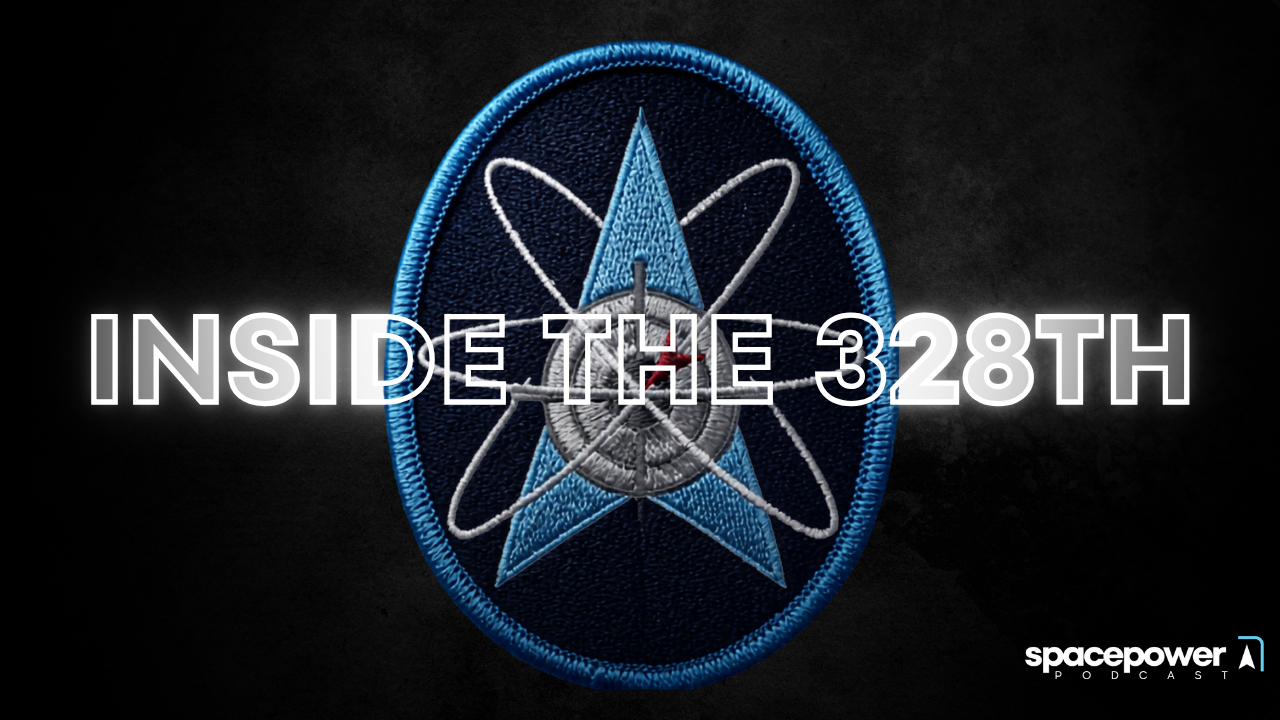
This year, that mission turns thirty. Space first earned a place at the United States Air Force Weapons School at Nellis Air Force Base in 1996, and the work has lived and grown there ever since, now carried by the 328th Weapons Squadron. SFA Founder Bill Woolfsat down with the squadron’s commander on the Spacepower Podcast to understand what three decades of building space warfighters has taught the force, and what the next thirty years will demand.
Lt. Col. Brian “Knuckles” Peterson commands the 328th Weapons Squadron, the United States Space Force’s weapons school, assigned to Space Delta 1 under Space Training and Readiness Command. He came up through missile warning, logged three combat deployments, and recently spent time inside the Space Force’s futures planning before taking command. That combination, an operator’s instinct paired with a strategist’s horizon, shapes how he describes the job. “I’m not necessarily building a planner,” Peterson said, “but I am building a problem solver.” Everything the squadron does flows from that sentence, and the stakes behind it are rising as the domain it trains for changes under its feet.
Building Problem-Solvers, Not Planners
The clearest way to understand the 328th is to compare it to its sister squadrons on the flight line. “The 16th Weapons Squadron takes the best F-16 pilots in the world and makes them even better,” Peterson explained. “I take an SDA expert, an OW expert, an EW expert, and I make them knowledgeable on all the mission areas.” Space domain awareness, orbital warfare, and electromagnetic warfare are three separate disciplines, and the school’s job is to take experts in one and make them fluent in how all of them fight together.
That fluency is taught through failure, on purpose. The school runs a crawl, walk, run progression that builds toward a capstone where students lead crews they have never met through a realistic combatant command scenario. Along the way, the culture is engineered to let people fall short while it still costs nothing. “I want people to fail here,” Peterson said, so they learn how they react to it and how to adapt before the stakes are real.
The mechanism that turns failure into expertise is the debrief, the ruthless, honest accounting of what went wrong and why. For many young Guardians it is the first time a top performer has to sit with a mistake instead of moving past it. “There’s no greater way of learning than acknowledging and understanding your failures,” Peterson said. The point is not punishment. It is observation, the ability to catch your own error in real time and trace it to its source. Master that, and you can solve problems no checklist anticipated.
Closing the Loop Between Operators, Testers, and Acquisition
The second theme of the conversation is one of the most consequential challenges in national security space, and it has nothing to do with any single satellite. It is about the gap between the people who build capabilities and the people who fight with them.
Peterson named the failure mode directly. “One of the cardinal sins we’ve always made is we’ve built the widget and then we’ve figured out how to fight the widget after the fact.” A system gets designed against yesterday’s threat, moves through test in its own lane, and reaches operators who discover it does not match the fight in front of them. Closing that loop, getting operators to articulate how they intend to fight five and ten years out so acquisition and test can build toward it, is the feedback cycle he wants weapons officers to drive.
It connects to the deeper purpose that anchors the whole school. The Space Force does not pursue capability for its own sake. “Everything we do to gain space control and have space superiority is to support the joint force,” Peterson said. Opening windows in an adversary’s surveillance network, degrading the systems that cue their long-range fires, protecting the communications a ground commander depends on, all of it exists to enable the larger fight. The weapons officer’s value is not knowing the most about a console. It is understanding why the mission matters to everyone else and integrating accordingly.
A Community, Not a Silo
The quietest and most important part of the conversation was about belonging. Peterson is adamant that the schoolhouse is not a factory that graduates students and forgets them. Nellis and the 328th, in his words, should be home base for the community. The patch is a permanent membership, not a credential. “If someone’s got a patch on their shoulder, I’m going to do everything I can to make sure I’m helping them,” he said, “and I would expect the same.”
That instinct scales outward. Peterson’s warning to his own community is that expertise kept inside the squadron is wasted. Weapons officers, he argued, have to be evangelists for the mission, willing to teach the joint force and the people who fund it, not just each other. “If we can’t explain what we’re doing to others, we’re going to fail.” The hardest skill is not the orbital math. It is translation.
SFA Founder and host Bill Woolf knows that personally. A weapons school graduate and instructor himself, Woolf credits the school’s problem-solving culture for the confidence to build something from nothing. “I leaned into standing up the Space Force Association because of the problem solving nature and capabilities I learned at weapon school,” he said during the conversation. The mindset the 328th instills does not stay on an operations floor. It builds institutions.
Why This Conversation Matters
Thirty years in, the space weapons school has produced only a few hundred graduates. That is a small number against everything the Space Force is being asked to do, which is exactly why the community Peterson describes matters so much. A force this young cannot afford siloed excellence. It needs experts who connect, who teach, and who carry the mission outward to the joint force, to Congress, and to the public that ultimately decides what gets funded.
That ethos of connection beyond the silo is the reason the Space Force Association exists, and it is why SFA is helping the 328th mark this milestone directly. In collaboration with the squadron, SFA is hosting the 328 WPS 30th Anniversary Social and Golf Tournament at Nellis this June, bringing Space Weapons School graduates back together to reconnect and reflect on three decades of the course. Beyond the camaraderie, the sponsors supporting the anniversary fund the celebration and participation costs for the active-duty Guardians still doing the work, the same up and out instinct Peterson says his community can never neglect. Hear Lt. Col. Peterson explain what the next thirty years will demand in his own words:
Listen to the full episode on Spotify | Apple Podcasts | YouTube
Lt. Col. Brian “Knuckles” Peterson, Commander, 328th Weapons Squadron, United States Space Force Peterson commands the U.S. Space Force’s weapons school at Nellis Air Force Base, where the Space Superiority Weapons Instructor Course trains the tactical and operational experts who lead space warfighting across the force.
Learn more about the U.S. Space Force: https://www.spaceforce.mil/
Join SFA: https://ussfa.org/