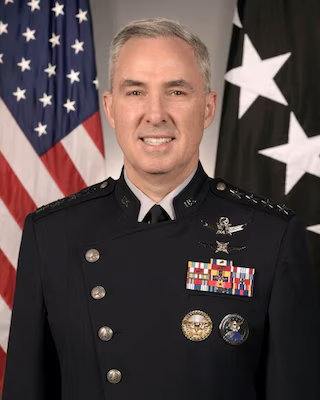
SUMMARY: On the Spacepower Podcast, U.S. Space Command Commander Gen. Stephen Whiting discusses deterrence, partnerships, and why space is increasingly central to security in the Indo-Pacific.
When most people think about the Indo-Pacific, they picture ships, aircraft, and contested waters stretching from the South China Sea to the western Pacific.
But according to Gen. Stephen Whiting, the conversation cannot start on the ocean or even in the air anymore.
It starts in space.
On a recent episode of the Spacepower Podcast, SFA Founder Bill Woolf spoke with the Commander of U.S. Space Command about how space capabilities underpin nearly every aspect of modern military operations. From missile warning and communications to precision navigation and intelligence, space systems quietly enable the operations that shape security across the Indo-Pacific.
The result is a strategic reality that is becoming impossible to ignore. Control of the space domain increasingly influences what happens on Earth.
The Indo-Pacific Is Not Just a Maritime Theater
For decades, the Indo-Pacific has been described primarily as a maritime theater. Naval power, freedom of navigation, and trade routes dominate the conversation.
But modern military operations depend on space in ways that previous generations of commanders never had to consider.
Space systems allow forces to communicate across vast distances, guide precision weapons, and monitor developments across enormous geographic areas. In a region as large and complex as the Indo-Pacific, those capabilities are indispensable.
During the conversation on the Spacepower Podcast, Gen. Whiting explains how U.S. Space Command thinks about providing those capabilities to combatant commanders while also ensuring they remain available during crises or conflict.
That challenge is becoming more complex as competitors develop ways to interfere with space systems.
The Growing Counterspace Environment
One of the more candid parts of the discussion focuses on the evolving counterspace landscape.
Potential adversaries are investing heavily in capabilities designed to hold satellites at risk. Some of these systems are kinetic, while others aim to disrupt or degrade satellite functionality without destroying them outright.
Either way, the implication is the same. The space domain is no longer a sanctuary.
Gen. Whiting describes how these developments are changing the way military planners think about resilience and deterrence in space. Ensuring that the United States and its allies can continue operating even in contested space environments is becoming a central part of national security strategy.
The full conversation explores how U.S. Space Command approaches that problem and how the command works with other combatant commands to ensure space support remains reliable when it matters most.
Partnerships Are Becoming a Strategic Advantage
Another major theme of the episode is partnerships.
Space operations do not occur in isolation. Satellites cross international borders every ninety minutes, and the information they provide often supports coalition operations.
For that reason, cooperation with allies and partners has become increasingly important. Countries across the Indo-Pacific are expanding their own space capabilities, opening new opportunities for collaboration in areas like space domain awareness, data sharing, and operational coordination.
In the podcast discussion, Gen. Whiting highlights the importance of relationships with like-minded nations, including India. These partnerships help build a shared understanding of activity in space while strengthening collective deterrence.
As space becomes more contested, cooperation becomes a force multiplier.
Preparing for a Future Where Space Matters Even More
Space has long been important to military operations, but its role continues to expand.
Future conflicts will likely depend even more heavily on space-enabled capabilities, which means protecting those systems and ensuring their continued operation will be critical.
Gen. Whiting frames U.S. Space Command’s mission around several core responsibilities. The command must deliver space capabilities to the joint force, protect U.S. and allied space assets, and defend forces against threats that originate in or rely on space.
Those responsibilities are not theoretical. They shape daily operations and planning across the command.
The conversation on the Spacepower Podcast offers a rare look into how leaders responsible for the space domain think about those challenges and how they are preparing for the future.
A New Chapter for the Spacepower Podcast
This episode with Gen. Whiting also marks the beginning of a new chapter for the Spacepower Podcast.
The program has recently undergone a significant upgrade in both format and production quality as part of the Space Force Association’s broader effort to elevate conversations about national security space. Episodes now feature a more structured format that begins with a strategic framing of the topic before transitioning into in-depth discussions with senior leaders across government, industry, academia and civil space.
The goal is simple: to create a forum for thoughtful, substantive dialogue about the operational realities shaping the space domain.
Listeners can also expect to hear a mix of guest conversations and solo episodes hosted by Woolf, where he will offer analysis and commentary on emerging trends in space operations, deterrence, and strategic competition. These discussions are designed to help unpack complex developments and connect the dots across policy, technology, and operational strategy.
Together, these changes aim to make the Spacepower Podcast a trusted source for professionals who want to better understand how space is shaping the future of national security.
And there are few better ways to launch this new chapter than with the Commander of U.S. Space Command himself.