
When Congress hears “the Space Force needs to double in size,” most assume it’s a budget argument. A bigger number, a bigger ask. But that framing misses the point almost entirely.
The case Chief Master Sergeant of the Space Force John Bentivegna has been making, before the Senate Armed Services Committee, and in this conversation with SFA Founder Bill Woolf, isn’t about filling seats. It’s about building a service that can win. And those are two very different things.
“Everything starts with requirements,” Bentivegna said. “What is it that the nation has asked the Space Force to do? And that ask is getting greater and greater.” The growth argument, in his telling, begins not with personnel math but with threat reality, and the gap between what adversaries are building and what the United States needs to counter it.
A Service Built Differently: The Enlisted Operator Model
One of the most distinctive things about the Space Force is something most people don’t know: enlisted Guardians are the primary operators. They’re the ones at the console. Officers plan and integrate. That’s a deliberate inversion of how most people picture the military working.
Bentivegna walked through why. “We have a demand signal,” he explained, “especially from our senior captains and majors across the combatant commands, three-letter agencies, the joint staff, our allied partners. They are looking for space-minded warfighters, subject matter experts that they can integrate into their operational planning.”
That realization reshaped how the Space Force thinks about talent. Officers freed from tactical operations can represent the service where it needs representation: in joint planning, in combatant commands, in allied partner organizations where there may be only two or three Guardians on a staff. Meanwhile, the enlisted cadre goes deep. They learn the weapon systems. They fight them. They own the tactical level.
What that looks like inside an operations center is specific. Bentivegna described a Delta 1 TAC 15 ops floor where an enlisted sensor operator monitors a ground-based sensor network, tracking what’s in maintenance, what’s not, managing the architecture. When a threat arises unexpectedly, that operator makes a recommendation up to an officer space battle manager, who directs the response. Alongside them: an intelligence operator feeding analysis in real time, and a cyber protection specialist monitoring the network for adversary activity. “Those enlisted operators are all collecting that information, coming up with recommendations, and then feeding that to the officer,” Bentivegna said.
Officers direct. Enlisted operators drive. And the whole system depends on people who can think and act at speed, because the nature of the space fight demands it.
World-Class Master Sergeants: The Center of Gravity
If the enlisted operator model is the architecture, the World-Class Master Sergeant initiative is where it gets built. Bentivegna has been explicit about why the Space Force’s enlisted development framework stops at E-7 rather than E-9: because that’s where the warfighting work lives.
“A world-class master sergeant,” he explained, “is somebody who can tackle all those challenges, maybe where in other services there were E-9s doing that, or maybe even lieutenants.” These are operators who understand not just their functional specialty but the full mission area. Not just GPS, but the entire missile warning architecture. Not just space domain awareness, but orbital warfare and space control.
The parallel framework on the officer side tells the same story from a different angle. The Space Force’s officer career framework, released recently, peaks development investment at O-5, squadron commander level. “If we focus on and have a cadre of strong E-7s and strong, competent O-5s,” Bentivegna said, “making O-6 or E-8 and above is cake because the bench is there.”
The logic is sound: pour investment into the levels where warfighting actually happens, and senior grades become a natural outcome of a deep, capable force, not a destination you’re racing to fill.
Building a Bigger Force Without Losing What Makes It Good
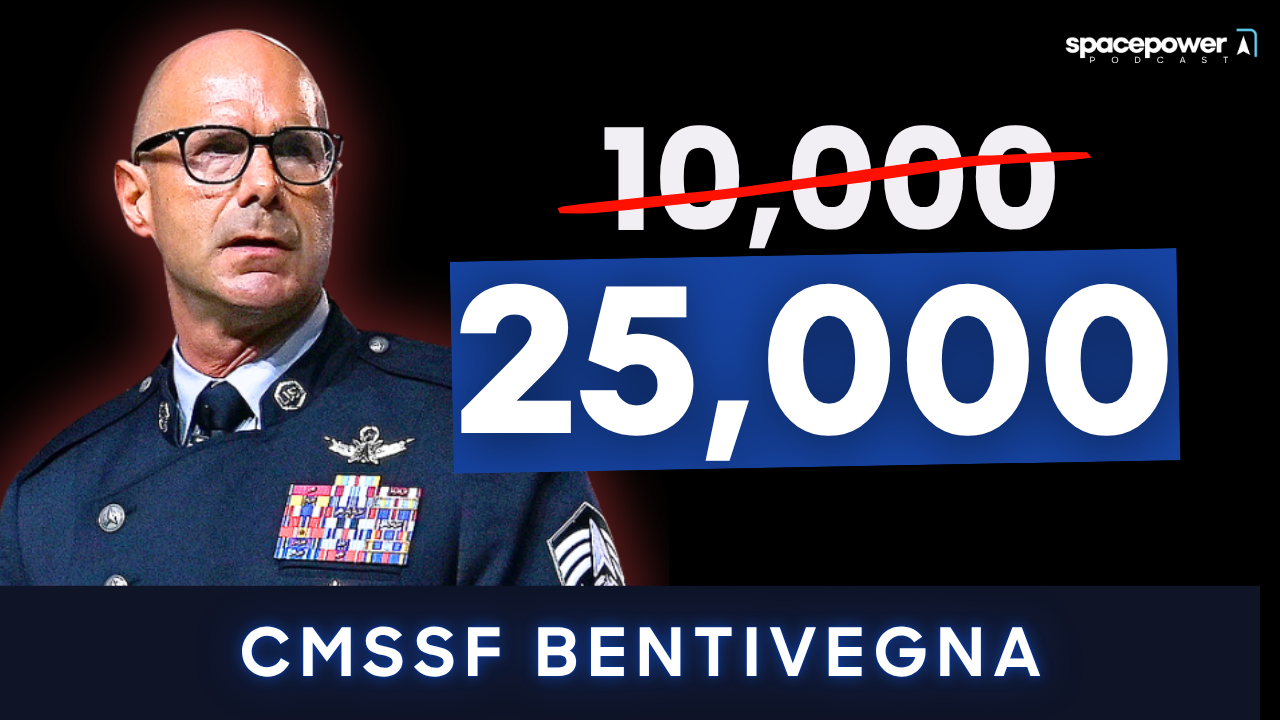
So where do the next 10,000 Guardians actually come from? Bentivegna was direct about the math and the timeline. The goal is 25,000 uniformed Guardians by 2031, with roughly 2,800 in end-strength growth in fiscal year 2027 alone. And he was clear that the infrastructure has to keep pace. “This is not just about personnel numbers,” he said. “It’s the entire ecosystem across the Space Force that are in the discussion.”
The recruiting pipeline pulls from multiple streams: new accessions from civilian life, crossflows from the Air Force, and inter-service transfers. The Space Force already exceeded its FY2026 enlisted recruiting goal, 125 percent of target in the first five months, but Bentivegna wasn’t satisfied with the story that tells. Growing to 25,000 requires expanding every element of the pipeline simultaneously.
On the officer side, that means the Academy, ROTC, and Officer Training School, including a pathway for world-class master sergeants who’ve maxed out enlisted advancement opportunities. “If you have your degree and you have an interest, why don’t you go to OTS? You still stay on the team, serve in a different capacity. We benefit from those years of experience.” Retention of institutional knowledge, not just recruitment of new faces.
The Personnel Management Act adds another dimension: a single-component model where all Guardians are either full-time or part-time, with easier movement between the two. For industry, that means something specific. “We have a history of leveraging the talent who may be working as a program manager for a space-based system in industry one day, and then the next week they’re in uniform,” Bentivegna said. That relationship has to be maintained and deliberately strengthened as the service grows.
Why the Urgency Is Real
None of this exists in a vacuum. Bentivegna was direct about the threat driving all of it.
China has built ground-based jammers, ground-based lasers, on-orbit inspection capabilities, and an ISR architecture that gives them persistent over-the-horizon tracking across the South China Sea and beyond. In 2024 or 2025, one of their satellites physically latched onto a defunct Beidou navigation satellite and moved it to a graveyard orbit, a demonstration of on-orbit manipulation capability with obvious military implications. “Think about the capabilities that China is putting on orbit,” Bentivegna said. “They are putting joint forces at risk with the architecture that they are building.”
Space superiority, in that context, isn’t an abstract concept. It’s the ability to maneuver freely in the domain and to deny an adversary the same freedom. Every Guardian the Space Force trains, every ops center it builds, every capability it develops is part of an answer to a very specific threat that isn’t waiting for the budget cycle to catch up.
The analogy Bentivegna uses stays with you: a Navy that protects the sea lanes makes cruise ship passengers free to enjoy the buffet without scanning the horizon for pirates. The Space Force is building the same kind of presence, unglamorous, persistent, essential, for a domain that underpins GPS, financial systems, weather forecasting, and the targeting capability of every U.S. military service. “It’s going to be the Guardians of the United States Space Force that people are looking to to secure freedom of unfettered access to that domain.”
That’s the argument. Not a bigger number. A better-built service, sized to the threat, equipped to win.
The full conversation, covering SPAFORGEN force generation cycles, Guardian Arena, and the mechanics of legislative end-strength authorization, is worth hearing in full. Listen to the episode wherever you get your podcasts