
Training tells you how to do the job. It doesn’t tell you why the job exists. For most of military history, that distinction didn’t matter much. The mission was clear, the enemy was visible, and the stakes were obvious. But space is different. It’s invisible, contested, and deeply misunderstood, even inside the government agencies that depend on it most. The Space Force recognized early that operators alone weren’t enough. It needed thinkers. And thinking, unlike operating, has to be taught.
That insight is the foundation of Space Delta 13 (DEL 13), the United States Space Force’s dedicated education command and one of five deltas operating under Space Training and Readiness Command (STARCOM). While other deltas focus on initial training, doctrine, advanced qualification, and testing, Delta 13 does something different: it builds the intellectual infrastructure that makes everything else possible. It’s the delta that asks why.
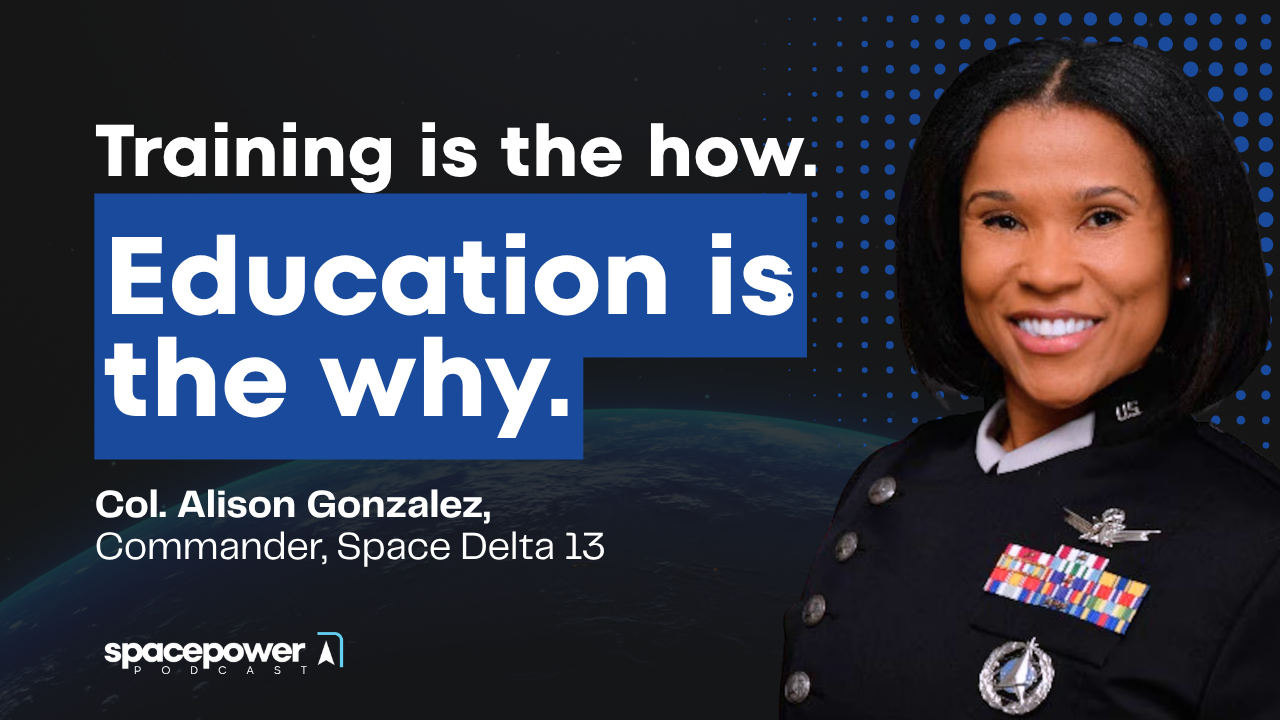
Col. Alison Gonzalez, commander of Space Delta 13, sat down with SFA Founder and host Bill Woolf at the 41st Space Symposium, recorded live on the Redwire stage, to explain what that mission looks like in practice and why the Space Force couldn’t accomplish its national security mission without it.
Training Is the How. Education Is the Why.
The distinction Col. Gonzalez drew early in the conversation was sharp and deliberate. “You cannot have effective training without an education underpinning,” she explained. “Training is the how. Education is the why.” It sounds simple. The implications are enormous.
A Guardian who knows how to operate a military satellite communications system is an asset. A Guardian who understands why that system exists, what it enables, what adversaries want to disrupt, and how its loss would cascade across diplomacy, economics, and combat operations, is a different kind of warfighter entirely. Delta 13 exists to develop the second type.
The mission runs on three pillars. The first is professional military education (PME): the squadron officer school-equivalent courses, enlisted PME, and officer development programs built specifically for Guardians. The second is professional continuing education, what Gonzalez called the “bedrock” of Guardian development, a set of programs that follow Guardians across every phase of their career, from the most junior specialist or lieutenant through general officers. The third is professional partnership education: fellowships, research programs, and industry experiences that send Guardians into outside organizations with real operational problems to solve, then bring those solutions back to Space Force leadership.
Delta 13 is headquartered at Joint Base Andrews, Maryland, and operates six institutions spread across seven states. The scale reflects the scope. “We educate everyone,” Gonzalez said, “from the United States government and the American population on Space Force,” a mandate that stretches far beyond what most people assume a military education command does.
Building a Space Education Ecosystem Across the Joint Force and Beyond
What makes Delta 13 genuinely unusual isn’t just who it educates. It’s who it educates alongside Guardians. The delta doesn’t limit its mission to Space Force personnel. It educates the joint force, international allies and partners, industry, and academia. Gonzalez was direct about why: “Partnerships is the bedrock of Delta 13. We could not do our mission without the joint force, the interagency, with industry and academia.”
That means Guardians are sitting in classrooms and programs with officers from other services, officials from other agencies, and professionals from the private sector, all working through the same core question of what space means for national security. It’s an integration model designed to break down the information silos that have historically kept space expertise locked inside a narrow community.
The university partnerships are central to this. Delta 13 has active relationships with institutions including Texas A&M, Arizona State, and Purdue, leveraging what Gonzalez described as “world-class faculty” to supplement military instruction. In January 2025, STARCOM officially launched a Captain’s Leadership Course at Texas A&M, a curriculum combining Master’s-level academic concepts with military professional development, aimed at building Guardians who can think critically and lead across joint and interagency environments.
Industry is equally in the picture. “Industry has a huge training and education ecosystem as well,” Gonzalez noted. “Where can we harness and leverage those best practices and do various program exchanges?” Rather than treating commercial space as a supplier relationship, Delta 13 is embedding Guardians in industry environments to understand how the private sector operates and bringing that perspective back into the force.
Gonzalez was candid about why the partnership model isn’t just philosophically appealing. It’s operationally necessary. “I have a very small delta,” she said. “They are small, mighty, and crushing it every day of the week, but we also have to leverage the talent that’s out there as well.”
A Guardian Who Wore History and Kept Moving Forward
Before Gonzalez was a delta commander, she was a satellite operator. She spent years working military satellite communications programs, moving through roles as an operator, engineer, instructor, and evaluator. She went deep into the National Reconnaissance Office (NRO), worked the Defense Meteorological Satellite Program, and cycled through special programs, congressional assignments, and the broader Intelligence Community. Most recently, she served as Director of Staff for the Office of the Chief of Human Capital at Headquarters U.S. Space Force before assuming command of Delta 13 in July 2025.
She’s also, as it turns out, one of the first Guardians to publicly demonstrate the Space Force service dress uniform, a fact Bill raised during their conversation on the Redwire stage that Gonzalez acknowledged with characteristic directness. “I don’t know if I’d use the term model,” she said. “I definitely demonstrated it.” She described being asked to do wear testing, one thing leading to another, and suddenly finding herself on a stage and in international rollouts, on CNN, representing a service that was just finding its identity. “Despite all of that,” she said, “I’m just so proud that I’m seeing guardians in the audience and here. It’s incredible. I would do it all over again.”
That combination of grounded humility and forward momentum runs through everything she described about Delta 13. When asked about her vision for the command’s future, she didn’t reach for abstract language. She described seamless integration, a future state where you can’t tell a uniformed Guardian from an interagency partner or an international ally because the education ecosystem has made that level of integration possible. “My vision is whatever the education ecosystem, it is integrated seamlessly with tech, it is tech-centric and driven, and it is seamlessly integrated across a joint force, interagency and academia and industry.” Artificial intelligence, quantum, and data are already in her sights.
Less than 10 percent of Americans know the Space Force exists. That’s not a communications failure. It’s an education gap, and it has real consequences. A public that doesn’t understand what the Space Force does can’t meaningfully support the investments, policies, and partnerships that space superiority requires. Delta 13’s mission, to educate Guardians, the joint force, allied partners, and ultimately the broader public on why space is a national security imperative, is one of the most important and least understood missions in the entire service.
Col. Gonzalez made that case with clarity and conviction. Hear her explain it in her own words. The full episode, recorded live at the 41st Space Symposium with support from Redwire, is worth the listen.
Listen to the full episode on Spotify | Apple Podcasts | YouTube
Learn more about Space Delta 13: https://www.starcom.spaceforce.mil/About-Us/Units/Space-Delta-13-Education/
Learn more about the U.S. Space Force: https://www.spaceforce.mil/